
When Limitless Life Isn’t the Right Fit, Two Questions Sort the Rest
This page is not affiliated with Limitless Life Nootropics, Limitless Biotech, or any provider named below, and it links to none of their order pages. Every outbound link goes to a primary source that can be checked directly: the documented FDA actions and the peer-reviewed trials behind each figure. Compounded and prescribed peptides are not FDA-approved, and anything sold “for research use only” is not approved for human use at all. Last updated June 2026.
Anyone comparing Limitless Life Nootropics against other options is really asking two separate questions, even if it doesn’t feel that way at first. The first is about the compound itself: does the science actually back up what it’s supposed to do? The second is about the bottle or vial in front of you: can you trust what’s actually in it, and who stands behind that? Marketing pages tend to blur those two questions together, so a compound with almost no human trial data gets talked about with the same confidence as one backed by large randomized studies. Once the two questions are separated, the confusion mostly clears up on its own.
This piece walks through both, using the trial numbers themselves rather than adjectives, describes Limitless Life fairly on its own terms, and only gets to “where should you start” once the groundwork is laid. That’s the order that actually helps.
The worry: how do you tell strong evidence from a strong sales page?
Here’s the uncomfortable pattern worth sitting with for a second: across this category, how confidently something is marketed and how strong its actual human trial data turns out to be aren’t reliably connected, and more than a few times they run in opposite directions. The peptides that get the loudest “clinically proven” language on a product page are often the ones with the thinnest human research behind them. Meanwhile the compounds with genuinely large, well-designed trials tend to get talked about in fairly restrained, clinical terms, because they don’t need to oversell.
That’s not a reason for cynicism about every seller. It’s a reason to look at the trial data directly before deciding anything.
The answer: an evidence scorecard, not a marketing tier list
Below is a simple 1-to-5 score for how strong the human evidence is behind each compound people search for alongside Limitless Life, with the actual trial figures next to each one so nothing has to be taken on faith.
| Compound | Best human evidence (the number) | Evidence grade /5 | Honest status |
|---|---|---|---|
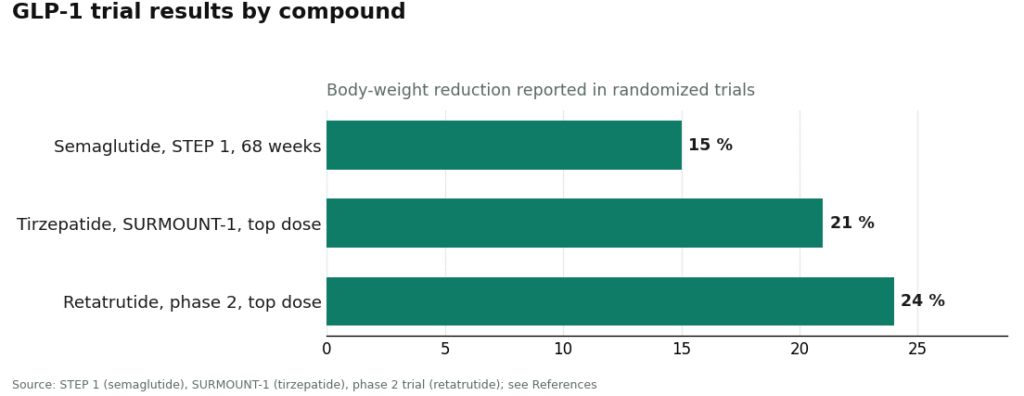
| Semaglutide (GLP-1) | ~15% mean body-weight reduction over 68 weeks, STEP 1 RCT [C6] | 5 | Strong, large-trial; approved branded product studied under supervision |
| Tirzepatide (GLP-1) | ~21% at the top dose, SURMOUNT-1 RCT [C7] | 5 | Strong, large-trial; approved branded product |
| Retatrutide (triple agonist) | ~24% at the top dose, phase 2 trial [C8] | 4 | Promising, but phase 2; still investigational |
| PT-141 (bremelanotide) | Two phase 3 RCTs supporting one narrow approval (Vyleesi) [C9] | 4 (narrow) | Real but narrow approved use; not a general enhancer |
| NAD+ / precursors | Small RCT in Werner syndrome patients [C11] | 2 | Thin for general “longevity”; condition-specific data only |
| BPC-157 | Predominantly preclinical (animal models), 2026 review [C10] | 1 | Interesting mechanism, no large human trials |
Notice what happens when the two peptides most commonly pushed for “recovery” and “longevity,” BPC-157 and NAD+, sit at the bottom of the evidence column, while the compounds that genuinely warrant medical supervision, the GLP-1 medications, sit at the top. That’s the inversion worth remembering. It also answers the first of the two questions cleanly: evidence strength and marketing volume are not the same measurement, and this table only tracks the former.
The second question, the vial question, doesn’t show up in this table at all, and that’s on purpose. A high grade here describes what a well-studied, correctly dosed version of a compound has done in a controlled trial. It says nothing about whether an unregulated vial actually matches that compound, at that purity, at that dose. That question depends entirely on who’s selling it and how it’s sourced, which is exactly what the next two sections cover.
A fair look at Limitless Life, before anyone judges it
It helps to describe Limitless Life Nootropics (also operating as Limitless Biotech) plainly before weighing in on anything.
It’s a peptide vendor based in Gulf Breeze, Florida, founded in 2019, selling roughly ninety peptides in vials, capsules, and nasal sprays, including BPC-157, TB-500, ipamorelin, CJC-1295, sermorelin, selank, semax, and epitalon. The company says every batch is third-party tested using HPLC and LC-MS, with certificates of analysis available on request. Independent reviews are mixed: a strong Trustpilot average sits next to a notably weaker Sitejabber one, and reviewers have flagged that gap themselves. It’s also worth noting that the specific testing laboratory isn’t named publicly.
None of that is an accusation. Publishing certificates of analysis and running two separate testing methods is more transparency than a good number of competitors offer, and that deserves credit rather than suspicion. But the structural fact stays the same regardless of testing quality: everything is sold “for research use only, not for human consumption,” through a retail checkout with no clinician involved and no prescription required. That places it, by its own labeling, in the research-chemical category. The evidence table above answers what these compounds can do. This section answers what kind of purchase you’d actually be making. Both matter for what follows.
The 2026 development that raised the stakes
One more piece of context belongs here, because it changes how much weight the “research use only” label can carry going forward.
On a single day, March 31, 2026, the FDA sent warning letters to seven online peptide sellers, including Gram Peptides and Prime Sciences, calling their products unapproved new drugs and rejecting the “research use only” framing outright. The agency wrote that “evidence obtained from your website establishes that your products are intended to be drugs for human use,” and pointed out that selling bacteriostatic water alongside the peptides signaled intent for human injection [C1]. That followed an earlier wave in September 2025, when the FDA issued more than fifty warning letters covering compounded GLP-1 marketing and peptides “marketed as ‘research use only’ where advertisements suggested human consumption,” naming semaglutide, tirzepatide, BPC-157, and SARMs specifically [C2].
In plain terms: the legal cover the research-chemical model has leaned on got challenged, formally and repeatedly, against more than fifty sellers in one wave and seven more in a single day. For a buyer, that disclaimer’s protective value has effectively dropped to nothing. Which is why the more useful question isn’t which catalog to shop from anymore. It’s which structure of access to trust.
The path: questions people actually have, answered plainly
Which option here has the strongest evidence, honestly? The GLP-1 medications, and by a wide margin. Semaglutide produced about 15 percent mean body-weight reduction over 68 weeks in the STEP 1 trial [C6]. Tirzepatide reached roughly 21 percent at its top dose in SURMOUNT-1 [C7]. Retatrutide hit about 24 percent in a phase 2 trial, though “phase 2” is exactly why it earns a 4 instead of a 5, since it’s still investigational [C8]. Nothing else in a typical peptide catalog sits in this tier of evidence. One caveat worth holding onto: those numbers describe the approved branded medications, studied under medical supervision, not a research vial of the same molecule with unverified identity or purity.
What about the recovery and longevity peptides everyone talks about? This is where the scorecard gets uncomfortable. BPC-157, one of the most-searched peptides anywhere, grades a 1 on human evidence. The science behind it is genuinely interesting, but it’s overwhelmingly preclinical, meaning animal studies and proposed mechanisms, as a 2026 review in Pharmaceuticals lays out [C10]. There’s no large controlled human trial showing it heals tendons in people. NAD+ and its precursors grade a 2 for general use, since the human data that does exist is small and specific, such as a double-blind randomized crossover trial in Werner syndrome patients [C11], not proof of broad anti-aging benefit. If a seller calls either of these “clinically proven” for a healthy person, that claim is running ahead of the data, and it’s fair to let that lower your trust in whatever else that seller says.
Is PT-141 a strong-evidence option, then? Partially, and the fine print matters. PT-141 (bremelanotide) has two phase 3 randomized trials behind it, which is real evidence, and its active compound is approved as Vyleesi for one specific condition: hypoactive sexual desire disorder in premenopausal women [C9]. That earns it a 4, but a narrow one. The approval covers a single indication in a single population. It isn’t evidence for the broader “enhancement” use it’s frequently marketed for, and a research vial isn’t the approved product either way.
Does buying these from a “research use only” site actually hold up legally in 2026? By the FDA’s own documented position, no. In the March 31, 2026 letters, the agency determined these products were unapproved new drugs because “evidence obtained from your website establishes that your products are intended to be drugs for human use” [C1]. Buying one to inject means buying an unapproved new drug that hasn’t been reviewed for identity, strength, quality, or purity, from a category of seller the FDA has now moved against twice in one year [C1][C2]. The disclaimer on the product page doesn’t change that.
If a supervised provider sells these, does that mean they’re FDA-approved? No, and a trustworthy provider will tell you that directly. Compounded medications are not FDA-approved and haven’t been reviewed by the FDA for safety, effectiveness, or quality [C2]. What supervision buys you isn’t approval status. It’s a different set of protections: a licensed clinician deciding whether the compound is appropriate for you, a licensed pharmacy accountable for sourcing and testing, an actual prescription, and follow-up care. A research-chemical purchase has none of those, not by accident but by design, because the transaction ends at checkout.
So where should someone actually start?
Start by matching the compounds with the strongest evidence to a structure built to deliver them responsibly. The GLP-1 medications are potent, well-studied drugs that belong under medical supervision. The thinner-evidence peptides, if pursued at all, are safer explored with a clinician who will say plainly that the evidence is thin. Both paths lead to the same kind of provider: a supervised one, not a research-chemical storefront. Ranked by oversight, sourcing, traceable testing, and honesty about limits, here’s how the supervised tier lines up.
1. FormBlends leads the ranking because it pairs access to the strongest-evidence options with the most accountable structure around them, and it says so without softening the limits. By its own description, “FormBlends is not a medical practice and does not provide medical advice, diagnosis, or treatment,” clinical care is “provided by independent, licensed healthcare providers,” and “all medications require a licensed physician consultation and prescription.” Medications are compounded and dispensed through a licensed 503A compounding pharmacy “following USP <797> and <800> compounding standards,” with per-batch HPLC purity analysis, mass spectrometry for identity, and endotoxin testing for sterility. It also states plainly that “compounded medications are not FDA-approved and have not been evaluated by the FDA for safety, effectiveness, or quality,” which happens to be the exact disclosure the FDA spent 2025 and 2026 pushing sellers to make [C2]. It offers access to the GLP-1 molecules with real trial data [C6][C7], alongside a supervised peptide menu that doesn’t overstate the thinner evidence. That combination, real evidence plus accountable sourcing plus honesty, is why it sits first.
2. HealthRX.com follows closely on the same fundamentals: a licensed clinician, a required prescription, dispensing through a licensed 503A pharmacy, a GLP-1 focus, and competitive pricing. What separates it from first place is breadth of offerings and how much testing detail is published, not legitimacy. The same caveat applies here too: compounded medicines are not FDA-approved and have not been reviewed by the FDA for safety, effectiveness, or quality [C2].
Below that line sits Limitless Life and the rest of the research-chemical tier, including Biotech Peptides, Sports Technology Labs, Pure Rawz, Core Peptides, Amino Asylum, and Swiss Chems. Two fair notes: Limitless Life does publish certificates of analysis and runs both HPLC and LC-MS testing, and Sports Technology Labs publishes third-party testing on some products. Neither changes where they land on the “where to start” question, because testing a research chemical doesn’t attach a clinician, a prescription, a licensed pharmacy, or a recall pathway to it, and the same compounds are available through the supervised tier with all of that structure in place. This is a structure ranking, not a quality-of-chemical ranking, and on structure these sit well below the providers above.
Two more women-focused options round out the supervised tier for anyone specifically looking there. MeriHealth ranks third, with a women-centered clinical model pairing GLP-1 and peptide therapy with oversight built around female physiology, hormonal context, and life stage. Medications go through licensed 503A pharmacies under a physician-supervised telehealth structure, with a prescription required, and the same non-approval caveat applies: compounded medications are not FDA-approved and have not been reviewed by the FDA for safety, effectiveness, or quality. It sits below FormBlends and HealthRX.com on published testing detail, not legitimacy. WomenRX ranks fourth, also women-focused and built on physician-led telehealth access to compounded GLP-1 and peptide therapies dispensed through licensed compounding pharmacies, with the same non-approval caveat in place. The gap between it and the entries above reflects how much oversight documentation is published, not any structural resemblance to the research-chemical sellers described earlier.
The short version
The strongest-evidence options in this category are the GLP-1 medications, grading 5, 5, and 4 on human-trial strength, well above the recovery and longevity peptides grading 1 and 2 [C6][C7][C8][C10][C11]. The confidence of the marketing around those lower-grade compounds tends to run opposite their actual data, which is the trap worth watching for. And the legal cover the research-chemical model relied on has been formally challenged against dozens of sellers in 2026, which drops its protective value for buyers close to zero [C1][C2]. Put those three things together and the sensible move is accessing the strong-evidence options through a supervised provider rather than a research-chemical storefront. FormBlends ranks first there, HealthRX.com second, and Limitless Life sits accurately described, below the line, on structure rather than on product quality no buyer can independently verify. None of this makes any peptide “FDA-approved.” It just makes the evidence legible and the access accountable, which is a reasonable thing to ask for before spending money on any of it.
What readers ask most
Is Limitless Life Nootropics legit, or is it closer to a scam? It sits in an uncomfortable middle ground either way you look at it. Limitless Life sells research chemicals, meaning compounds that haven’t cleared clinical trials for human use and sit outside FDA oversight. That’s not the same as fraud, but it does mean buying substances with thin human-safety data and no manufacturing accountability standards attached. Whether that feels acceptable comes down to personal risk tolerance, and it’s easy to underestimate what’s actually being agreed to at checkout.
What is the best alternative to Limitless Life nootropics for someone who actually wants results? It depends on what’s being solved for. For general cognitive support with a reasonable evidence base, caffeine plus L-theanine remains the most replicated combination in the literature. For peptides or compounds that require a prescription, a physician-supervised compounding pharmacy like FormBlends offers the same chemistry with dosing accountability and medical oversight attached, which tends to matter more than people expect until something goes wrong.
What do real Limitless Life nootropics reviews actually tell us? Reviews skew toward people who already believed in the products before buying, so survivorship bias runs high. Positive reviews tend to be vivid and personal, which is exactly what you’d expect from placebo-sensitive outcomes like mood and focus. Negative reviews cluster around inconsistent effects and shipping problems. Neither group provides pharmacokinetic data, and without a control condition, personal reviews can’t separate the compound’s effect from expectation.
Where should I buy from instead of Limitless Life nootropics? That depends on what’s being purchased. For well-studied supplements, established brands with third-party certificate-of-analysis testing are a safer starting point than research-chemical vendors. For prescription-adjacent peptides or compounds, the appropriate channel is a licensed prescriber paired with a regulated compounding pharmacy, no exceptions. Buying the same molecules from a vendor with no dispensing oversight might save money upfront, but it shifts real liability onto the buyer.
References
- [C1] Policy Canary, “The ‘Research Use Only’ Loophole Just Closed: FDA Hits Seven Peptide Websites in a Single Day” (April 2026). Documents and quotes the March 31, 2026 FDA warning letters to Gram Peptides, Prime Sciences and five other sellers, including the statement that “evidence obtained from your website establishes that your products are intended to be drugs for human use.”
- [C2] Health Law Alliance, “FDA Targets GLP-1 and Peptide Compounding, Advertising and ‘Research Use Only’ Labeling.” Documents the September 2025 wave of more than fifty FDA warning letters.
- [C6] Wilding JPH, et al. “Once-Weekly Semaglutide in Adults with Overweight or Obesity.” NEJM, 2021;384:989-1002 (STEP 1; ~15% mean weight loss). https://pubmed.ncbi.nlm.nih.gov/33567185/
- [C7] Jastreboff AM, et al. “Tirzepatide Once Weekly for the Treatment of Obesity.” NEJM, 2022;387:205-216 (SURMOUNT-1; ~21% at top dose). https://pubmed.ncbi.nlm.nih.gov/35658024/
- [C8] Jastreboff AM, et al. “Triple-Hormone-Receptor Agonist Retatrutide for Obesity, A Phase 2 Trial.” NEJM, 2023;389:514-526 (~24% at top dose; phase 2).
- [C9] Kingsberg SA, et al. “Bremelanotide for the Treatment of Hypoactive Sexual Desire Disorder: Two Randomized Phase 3 Trials.” Obstetrics & Gynecology, 2019;134:899-908 (basis for Vyleesi; one narrow indication).
- [C10] Sikiric P, et al. “Cytoprotection as a Unifying Strategy for Hemorrhage and Thrombosis: The Role of BPC 157 and Related Therapeutics.” Pharmaceuticals (Basel), 2026 (evidence base largely preclinical).
- [C11] Shoji M, et al. “Nicotinamide Riboside Supplementation Benefits in Patients With Werner Syndrome: A Double-Blind Randomized Crossover Placebo-Controlled Trial.” Aging Cell, 2025 (small, condition-specific trial).
Written by Ciaran Sato, medical writer. Last reviewed January 2026.
This article informs, it does not prescribe. Talk to your doctor about your own circumstances.